
How Long Does Google Take to Crawl and Index Pages?

You publish a new page or blog post, then check Google a few hours later and… nothing.
So how long should it actually take Google to find, crawl, and index a new page?
For years, the frustrating answer has basically been “it depends.” But in October 2026, Google gave us some unusually specific numbers.
At a Google Search Central Live event in Barcelona, Google’s Gary Illyes shared internal data showing typical and slower timelines for crawling, indexing, and other Google Search processes. The numbers were reported by attendees and later covered by Search Engine Roundtable and Search Engine Journal. Google has not published the slides as official documentation, so these numbers should be treated as benchmarks, not guarantees. But these seem accurate to me, as someone who is in the weeds of crawling and indexing every day.
First, Crawling and Indexing Are Not the Same Thing
Before looking at the numbers, there is an important distinction.
Crawling happens when Googlebot visits a URL and reads the page.
Indexing happens when Google processes that information and decides whether the page should be added to Google’s search index.
A page has to be discovered and crawled before it can be indexed. That means these timelines can stack on top of each other.
How Long Does Google Take to Discover a New Page?
According to the data presented by Google, the typical time to discover a brand-new URL is about 20 hours.
The slower end of the range, however, was listed as weeks to never.
That does not mean every new page will appear in Google within 20 hours. It simply means Google may become aware that the URL exists around that time.
Google’s public documentation remains more conservative. Google says that for most websites, new pages can take several days to be noticed and that website owners generally should not expect same-day crawling.
So for a normal business website, seeing Google discover a page within a day or two is great, but taking several days is not automatically a problem.
How Long Does Google Take to Index a Page?
This is where the new data gets especially interesting.
Google reported a typical end-to-end indexing time of about 1.5 hours once the indexing process is underway. In slower cases, indexing could take months or may never happen, particularly when Google has quality concerns about the page.
That 1.5-hour number needs some context.
It does not mean Google will index your page 90 minutes after you publish it.
Google first has to discover the URL and crawl it. Only then can the page move through Google’s indexing systems. Google specifically noted that these processes are connected, so a delay earlier in the process creates a delay later.
A more realistic sequence might look something like this:
| Google Search Process | Typical Time Reported |
|---|---|
| Discover a new URL | About 20 hours |
| Process a sitemap | About 24 hours |
| Render a page | Seconds, or hours if queued |
| Process meta information | About 45 to 90 minutes |
| Complete indexing | About 1.5 hours |
| Refresh a previously known URL | About 30 days |
These are reference points based on Google’s internal analysis, not deadlines Google promises to meet.
Why Can an Existing Page Take Longer to Update?
One of the more surprising numbers was the typical refresh time for a page Google already knows about: approximately 30 days.
This helps explain a common SEO frustration. You might rewrite a page, change the title, update the content, or improve the keywords and then wonder why Google still appears to be using the old version.
Google may simply not have recrawled the page yet.
The data also showed that title and search snippet changes typically appear within about one to two days once processed, although slower cases can take weeks or even months.
Does Submitting a Sitemap Make Google Index Pages Faster?
A sitemap helps Google discover the pages on your website, especially on new websites or websites with a large number of URLs.
According to Google’s newly shared data, sitemap processing typically takes around 24 hours, although it can take as long as 14 days in slower cases.
But submitting a sitemap does not guarantee that every page will be crawled or indexed.
Google describes a sitemap as a way to help its systems discover URLs, not a command requiring Google to index them.
That is an important distinction.
Can You Ask Google to Crawl a Page?
Yes.
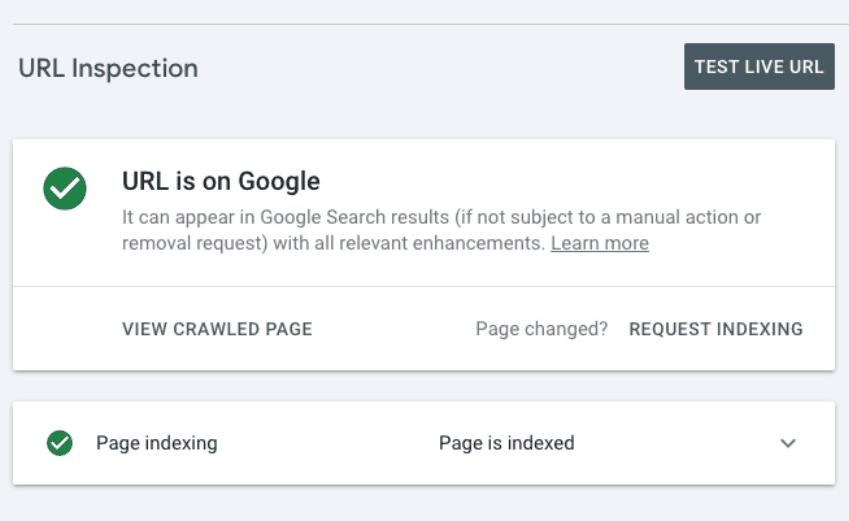
If you publish or significantly update an important page, you can use the URL Inspection tool in Google Search Console and select “Request Indexing.”
This can alert Google that the page should be revisited, but Google specifically says that requesting indexing does not guarantee immediate crawling or inclusion in search results. Submitting the same page repeatedly will not make Google crawl it faster either.
For larger numbers of pages, keeping your XML sitemap accurate and updated is generally the better approach.
Why Isn’t My Page Indexed Yet?
If a page has only been live for a day or two, there may be nothing wrong.
If it has been sitting unindexed for weeks, however, it is worth investigating.
Common problems include pages blocked by robots.txt, accidental noindex tags, incorrect canonical tags, broken internal linking, server availability problems, duplicate content, or pages Google does not consider valuable enough to include in its index.
Google has also made it clear that crawling and indexing are two separate decisions. Googlebot can successfully crawl a page without Google ultimately deciding to index it.
This is why “Google crawled the page” does not necessarily mean your technical SEO work is finished.
So, How Long Should You Actually Expect Google Indexing to Take?
For most business websites, expecting a new page to be discovered, crawled, and potentially indexed within a few days is reasonable. Sometimes it takes a week or longer. BUT just because it’s crawled or indexed, it does NOT mean that the page will magically show up first in searches overnight. That’s the part of the process that can take a lot of time to grow.
Google’s new internal numbers give us a much better look at what is happening behind the scenes, but they do not change one of the most important rules of SEO: Google does not guarantee that any particular page will be crawled or indexed within a specific amount of time. It can feel quite random (and frustrating) at times.
If an important page is still missing after several days, check it in Google Search Console. If weeks have passed, it is time to look more closely at technical issues, internal linking, crawlability, canonicalization, and the quality or purpose of the page.
The good news is that Google may be considerably faster at discovering and processing new content than many website owners assume. The less-good news is that getting Google to find your page and getting Google to actually want it in the index are still two different things.
If you’re needing help investigating indexing or SEO issues on your website, reach out anytime. Our team of skilled and experienced SEO specialists can help.
October 7, 2026
Serving clients across the globe and locally in Seattle, Tacoma, Bellevue, and across Washington.


